XBRL (eXtensible Business Reporting Language) is a standardized format required by the Accounting and Corporate Regulatory Authority (ACRA) for the electronic submission of financial statements in Singapore. It improves transparency, consistency, and comparability of corporate data.
🏢 Who Needs to File XBRL in Singapore?
Most Singapore-incorporated companies (except exempted categories) must file their financial statements in XBRL format when submitting their Annual Return to ACRA.
For smaller companies with revenue OR total assets ≤ SGD 500,000
PDF Only
Only allowed for certain exempted companies
🔎 ACRA’s BizFinx portal is used for generating and validating XBRL files.
⏰ Timeline for XBRL Submission
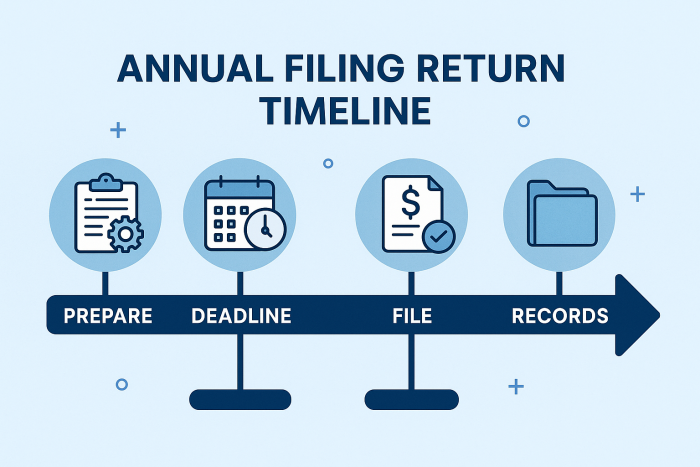
XBRL must be submitted alongside the Annual Return within:
✅7 months after Financial Year End (FYE) for private companies ✅5 months for public companies
📘 What is Included in Financial Statements?
A complete set of financial statements typically includes:
📌Statement of Financial Position (Balance Sheet) 📌Statement of Comprehensive Income (Profit or Loss) 📌Statement of Cash Flows 📌Statement of Changes in Equity 📌Notes to the Financial Statements 📌Directors’ Statement 📌Independent Auditor’s Report (if applicable)
**Each component must align with Singapore Financial Reporting Standards (SFRS).
❗Common Mistakes & Penalties
❌ Mismatched figures ❌ Missing mandatory tags in XBRL ❌ Submission in wrong format ❌ Late submission of Annual Return and XBRL
Penalties:
📌SGD 300–600 late lodgment fees 📌Rejections leading to compliance breaches
🟦Using outdated company officer info 🟦Filing late or skipping the Annual Return 🟦Not maintaining updated statutory registers 🟦Failing to appoint a company secretary
At Colab Advisory, we ensure your records stay compliant and updated year-round.
ACRA Enforcement Action for Annual Return Filing Breaches
Covers late lodgment penalties and legal consequences:
📌5% late payment penalty on outstanding tax 📌Additional 1% per month after 60 days
Court summons and fines up to SGD 5,000–10,000 or imprisonment for persistent non-filing.
GST Filing Penalties and Late Payment Fines
Late Filing Penalty
📌Immediate $200 fine once the return (GST F5/F8) is overdue. 📌Additional $200 per subsequent month, capped at $10,000 per outstanding return
Estimated Notice of Assessment (NOA) & 5% Penalty
➡️IRAS may issue an estimated NOA with 5% penalty on the assessed GST if the return isn't filed. ➡️Once the actual return is eventually filed, the 5% penalty is recalculated based on actual liability.
5% Late‑Payment Penalty + Additional 2% Monthly
➡️A 5% penalty is imposed for unpaid GST after the filing deadline. ➡️An additional 2% per month applies if the amount remains unpaid after 60 days, capped at 50% of the unpaid tax.
Recovery & Enforcement Consequences
Failure to comply may result in:
➡️Estimated NOAs, 5% penalties, and escalating 2% charges ➡️Appointment of agents (e.g. bank garnishment) ➡️Travel restrictions for sole-proprietors or partners ➡️Court summons and possible fines up to $5,000 per offence
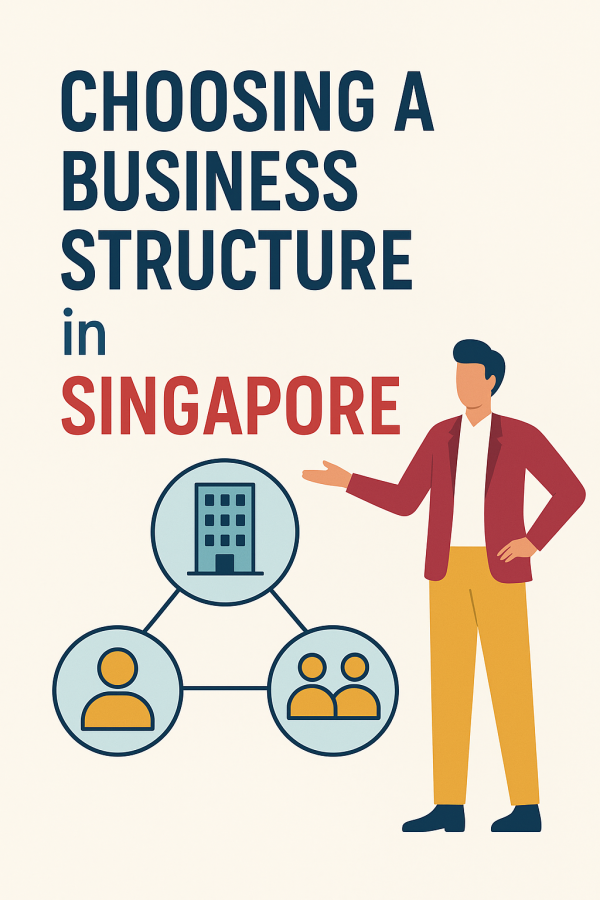
Choosing the right business structure is one of the most important decisions you'll make when starting a business in Singapore. The structure you choose affects your legal obligations, tax liabilities, and ability to raise funds. In this guide, we break down the common types of business entities available and provide key insights to help you make an informed decision.
Types of Business Structures
Sole Proprietorship
✅Owned by: 1 individual or company ✅Liability: Unlimited (personally liable for all debts) ✅Taxation: Taxed as personal income (not corporate) ✅Suitable for: Freelancers, consultants, low-risk businesses
Partnership
✅Owned by: 2 or more partners (up to 20 for general partnership) ✅Liability: Shared among partners; can be unlimited or limited depending on type ✅Types: General Partnership, Limited Partnership (LP), Limited Liability Partnership (LLP) ✅Taxation: Taxed individually (except LLP, which is separate) ✅Suitable for: Small firms, professionals (e.g. lawyers, accountants)
Private Limited Company (Pte Ltd)
✅Owned by: 1 to 50 shareholders (individuals or corporations) ✅Liability: Limited to paid-up capital ✅Taxation: Corporate tax (eligible for tax exemptions) ✅Compliance: Annual Return filing, AGM, directors’ duties ✅Suitable for: SMEs, startups seeking investment, scalable businesses
Comparison Table (Summary)
Feature
Sole Proprietorship
Partnership
Private Limited (Pte Ltd)
Legal Entity
Not separate
Not separate / LLP is separate
Separate legal entity
Liability
Unlimited
Unlimited / Limited for LLP
Limited to shareholding
Ownership
1 individual
2 to 20 partners (GP/LP)
1 to 50 shareholders
Taxation
Personal Income Tax
Personal Income Tax
Corporate Tax (17%)
Credibility
Lower
Moderate
High (preferred by banks)
Compliance
Minimal
Moderate
Annual filing and AGM required
Setup & Maintenance Cost
Low
Moderate
Higher
Suitable For
Freelancers, small business
Professionals, joint firms
Growth businesses, startups
How to Choose the Right Structure
When deciding which business structure to adopt, consider the following:
🔷Nature of Business: Is your venture a side hustle, or do you plan to scale and attract investment? 🔷Risk Level: Do you want to protect personal assets from business liabilities? 🔷Compliance Comfort: Are you ready to maintain annual filings and administrative requirements? 🔷Tax Considerations: Will your income benefit more from corporate tax rates or individual tax tiers? 🔷Brand Perception: A Pte Ltd may carry more credibility when dealing with corporate clients or financial institutions.
Still unsure? Our team at Colab Advisory is here to help you assess your needs and register your business smoothly.
What to Prepare Before Incorporating in Singapore?
✅Preparation of Necessary Documents: Ensure you have all required identification documents and consent forms ready to facilitate a smooth incorporation process. ✅Selection of Business Name and Address: Choose a unique business name for approval by ACRA and secure a registered address, preferably a commercial or virtual office, as P.O. boxes are not permitted. ✅Understanding Incorporation Requirements: Incorporating in Singapore requires at least one local resident director, a minimum share capital of SGD 1, and identification of your SSIC code for your business activity. ✅Appointment of Company Secretary: A company secretary must be appointed within six months of incorporation to ensure compliance with local regulations. ✅Basic Business Structure Setup: Define your business structure by selecting shareholders, directors, and appropriate share capital aligned with your business needs.
🔍 Tip: Prepare identification documents and consent forms ahead of time to expedite the process.